
Optimal Protein Distribution for Lean Muscle Maintenance
Build a practical protein routine across the day without treating every meal as a laboratory test or assuming a large dinner is wasted.
 Arjun5 min read
Suppose breakfast is coffee and toast, lunch is whatever fits between meetings, and dinner supplies most of the day's protein. Would moving some protein earlier be useful? Often it is a sensible planning change, but the explanation is more nuanced than a strict thirty-gram ceiling. Muscle maintenance depends on more than a clock: food intake, training, health, age and consistency all matter. This guide focuses on arranging protein across an ordinary day. For the separate question of whether a large serving is absorbed or wasted, see our protein-per-meal explainer.
Total intake comes before timetable perfection
The International Society of Sports Nutrition position stand gives a general daily range of 1.4–2.0 grams per kilogram for most exercising people and discusses distributing servings across the day. Those recommendations concern exercise nutrition; they are not a universal prescription for all adults. Body size, training and individual health needs change the conversation. The useful starting point is whether your normal meals provide enough, not whether a snack arrived at precisely the right minute.
A meta-analysis of protein supplementation during resistance training found additional benefits for muscle and strength, with its average relationship levelling off around a total intake of 1.6 grams per kilogram daily. That statistical estimate is not a personalised ceiling, and supplementation studies do not establish that powder is required. The broader lesson is to address inadequate intake before worrying about fine adjustments in timing. Adding an elaborate meal schedule cannot compensate for consistently insufficient food or the absence of a suitable training stimulus.
What distribution studies actually measure
In a small crossover study of eight healthy adults, a more even distribution of protein across meals produced higher muscle protein synthesis over twenty-four hours than a pattern weighted heavily towards dinner. Muscle protein synthesis means making new muscle proteins. The experiment supports a biological reason to consider distribution, but its size and short duration limit what it can tell us about years of muscle maintenance. A short-term difference in synthesis is not the same as a demonstrated long-term difference in muscle size or daily function.
A 2024 review of protein quantity and distribution makes that distinction important: the long-term implications for body composition remain less clear than the immediate meal response. Studies use different participants, amounts and methods, so a confident claim that one exact pattern always wins goes beyond the evidence. It is reasonable to use regular protein-containing meals as a practical default. It is not reasonable to tell someone that an uneven day inevitably puts their muscles into a harmful state.
Why there is no simple per-meal switch
A 2023 post-exercise experiment reported a larger and more prolonged anabolic response after a large protein dose than after a smaller one. It challenges an absolute cap on how much protein the body can use after a meal. The study's title should not be interpreted as advice to consume unlimited protein: it examined particular doses and conditions, not every possible intake or long-term outcome. Together with distribution research, it suggests a flexible picture rather than a hard on/off threshold.
The term leucine threshold can also sound more precise than a real meal allows. Leucine is one amino acid involved in the muscle-building response, but food supplies mixtures of amino acids and other nutrients. A writer cannot infer your ideal meal from a single headline number. Instead of checking every plate for a supposedly exact trigger, identify the main protein food and consider whether the portion makes sense within your day. The purpose is a sustainable routine, not an alarm system for missing a narrow biological window.
| Meal | Food-first options | Planning question |
|---|---|---|
| Breakfast | Yoghurt, eggs, tofu, milk or a suitable fortified soya drink | Is there a protein source I can prepare quickly? |
| Lunch | Beans, lentils, fish, chicken or tofu | Can I pack or buy a meal rather than miss it? |
| Dinner | A familiar protein food with vegetables and a starch | Does this fit the rest of my day? |
| Optional snack | A food that fills a real gap | Am I hungry or short on intake, rather than obeying a timer? |
Build from the weakest meal
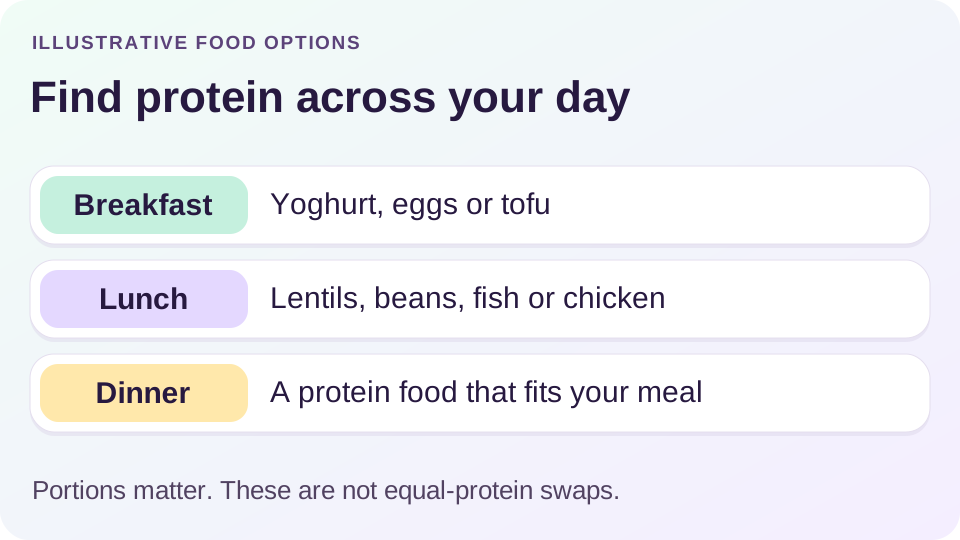
Look at a few ordinary days, including a busy one. If breakfast is consistently small, add something easy rather than redesigning every meal. If lunch disappears during work, solve the access problem: leftovers, a packed meal or a dependable shop option. If dinner already works well, leave it largely alone. This approach treats distribution as a practical way to improve consistency, not as a reason to reduce a satisfying evening meal before you know what the rest of the day provides.
A useful preparation task is choosing two alternatives for the meal you most often miss. One might be a home option, such as yoghurt with oats, and the other something available near work. Keep dietary preferences and cost in the decision. Beans and lentils can share a meal with grains; tofu or soya foods can provide another plant-based option. A meal does not have to imitate chicken and rice to count. Explore our more-protein collection for meal ideas that fit different budgets and routines.

Maintenance needs a wider plan
If maintaining muscle is your goal, do not judge progress only by the number on the scale or the grams written in a food app. Think about the training you can sustain and the everyday tasks you want to keep doing. Someone returning after illness, losing weight unintentionally or having difficulty eating needs more than a general internet schedule. A dietitian or clinician can help identify whether appetite, swallowing, medical treatment or another issue is limiting intake. A timetable should support that plan, not replace it.
People with kidney disease or other conditions requiring a prescribed diet should not adopt a sports-protein target without individual advice. Likewise, someone with a history of disordered eating may find detailed tracking counterproductive. You can use regular meals and familiar portions as an organising approach without logging every gram. If your current routine is already adequate and comfortable, there may be no useful reason to add another snack. More complexity is not itself evidence of better nutrition.
A flexible week beats a perfect day
Choose a single adjustment and see whether it solves a real obstacle. Pack lunch before a busy shift, keep an acceptable breakfast in the fridge, or plan a meal after training when that suits your day. If one day becomes uneven, return to your routine at the next opportunity rather than compensating with forced eating. Judge the change by practicality, appetite and your wider goals. Protein distribution is a helpful organising idea; it should make adequate eating easier rather than create another set of rules to fail.
Try this week
0 of 3 doneSources
- International Society of Sports Nutrition Position Stand: protein and exercise. JISSN, 2017.
- Effect of protein supplementation on resistance training-induced gains. British Journal of Sports Medicine, 2018.
- Dietary Protein Distribution Positively Influences 24-h Muscle Protein Synthesis. Journal of Nutrition, 2014.
- The anabolic response to protein ingestion during recovery from exercise. Cell Reports Medicine, 2023.
- Impacts of protein quantity and distribution on body composition. Frontiers in Nutrition, 2024.
Pass it on
XBlueskyEmail