A beginner gym workout plan you can actually follow
A simple three-day full-body plan, how heavy to lift, and how to keep progressing without getting hurt.
 Camila7 min read
Walking into a gym for the first time can feel like arriving at a party where everyone knows the rules except you. There are machines you do not recognise, people who seem to know exactly what they are doing, and a nagging worry about getting something wrong. The good news is that a beginner does not need a complicated programme. A handful of well-chosen exercises, repeated two or three times a week and made slightly harder over time, will build strength for months. This guide gives you a simple plan and explains the reasons behind each part of it, so you can adjust it with confidence.
Why full-body sessions suit beginners
The American College of Sports Medicine's position stand on resistance training recommends that novices train two to three days a week. Full-body sessions make the most of that time, because every muscle group gets worked each session. That matters: a meta-analysis in Sports Medicine found that training a muscle group at least twice a week produced more muscle growth than once a week when the total amount of work was similar. Split routines that train each muscle once a week, common in magazines, make more sense later, if at all.
At a glance
Training each muscle more often
Effect size (ES) for muscle growth; higher means more. Twice a week beat once at similar work.
Full-body training also keeps each session simple. You repeat the same handful of movements, which helps you learn them well. If you want to practise before your first visit, the NHS strength exercises guide shows home versions of several of these patterns, such as sit-to-stands and wall press-ups, using a sturdy chair and a wall.
The plan: three days a week
Do the session below on three non-consecutive days, such as Monday, Wednesday and Friday. If three days is too many, two still works well. Start each session with five to ten minutes of easy cardio, then do one or two light warm-up sets of your first exercise before the working sets. Use the easier option for any movement that feels awkward or uncomfortable at first.
| Exercise | Sets × reps | Easier option |
|---|---|---|
| Goblet squat or leg press | 3 × 8–12 | Sit-to-stand from a bench |
| Dumbbell or machine chest press | 3 × 8–12 | Wall or incline press-up |
| Seated cable or dumbbell row | 3 × 8–12 | Resistance-band row |
| Romanian deadlift with dumbbells | 2 × 8–12 | Hip hinge with a light kettlebell |
| Dumbbell shoulder press | 2 × 8–12 | Lighter dumbbells, seated |
| Plank | 2 × 20–30 seconds | Plank with knees down |
How heavy should it feel?
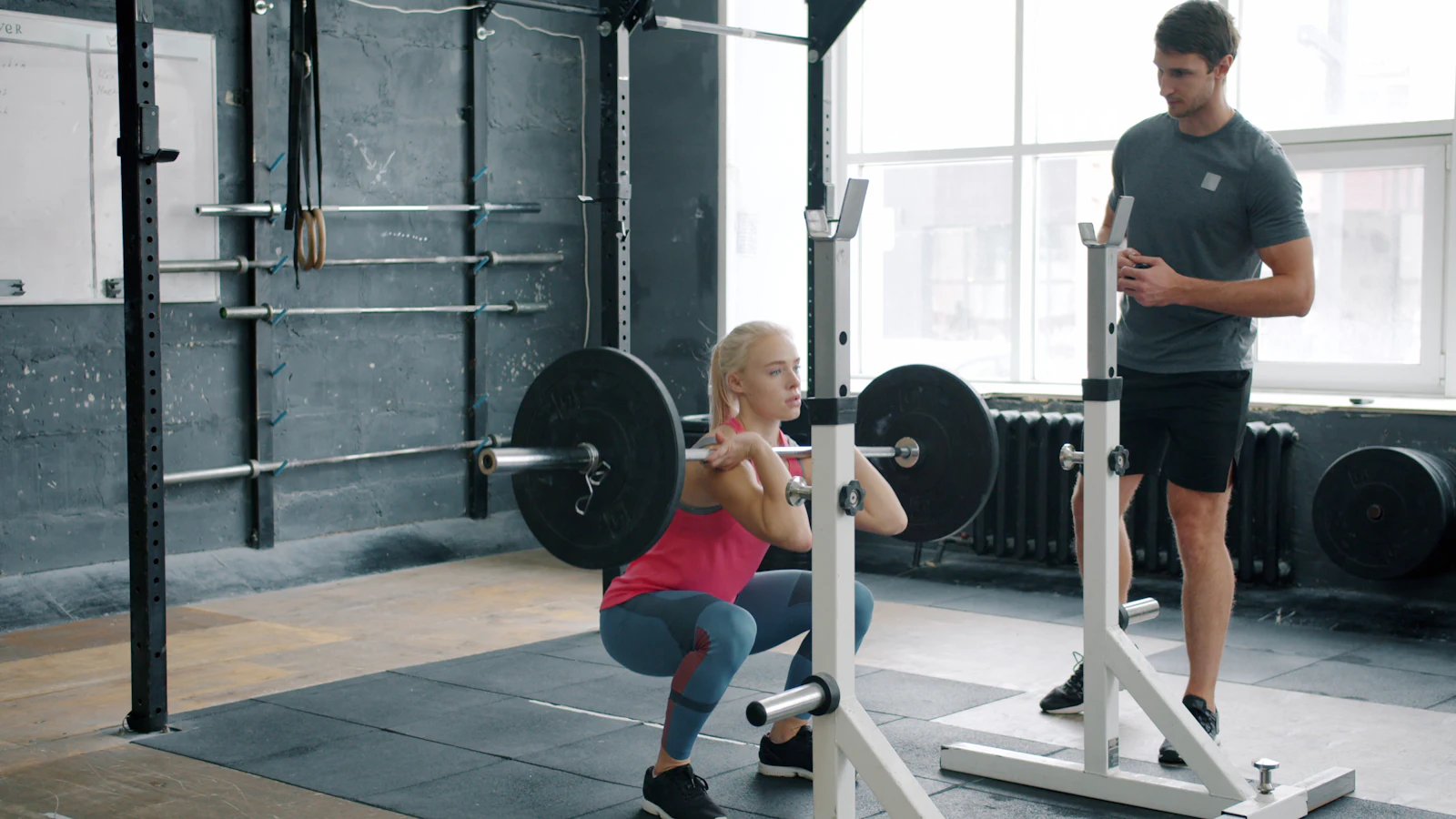
Choose a weight you can lift for the target number of repetitions with good form, where the last two or three reps feel genuinely hard but you could still manage one or two more. You do not need to train to complete failure: a 2023 meta-analysis found no evidence that taking sets to momentary failure built more muscle than stopping short of it. Stopping a rep or two early keeps your technique tidy and makes the next session easier to recover from.
The 8–12 range is a sensible starting point rather than a magic number. A review of 21 studies found that light and heavy loads produced similar muscle growth when sets were taken to failure, while heavier loads built more maximal strength. For beginners, moderate weights are simply easier to learn with and less daunting. Our guide to sets and reps explains the options in more detail once you are ready.
How to progress week by week
Progress is what turns a routine into a plan. ACSM suggests increasing the load by 2–10% once you can perform the current weight for one or two repetitions more than your target. In practice, if your target is 3 sets of 10 and you manage 12 on every set, add the smallest weight increase available next time. If you cannot add weight, add a repetition or a set instead. Write everything down, on paper or in your phone, so you are building on facts rather than guessing.
Expect progress to be quick in the first months, as you learn the movements, and slower after that. Some weeks you will repeat the same weights, and that is normal. If a joint hurts, rather than your muscles simply feeling worked, stop that exercise and get advice from a qualified trainer or physiotherapist. Mild muscle soreness a day or two after a new session is common and usually settles as your body adapts.

Your first month, week by week
The first few weeks are about learning, not lifting as much as possible. A gradual start helps your technique settle, reduces soreness and makes the routine easier to keep. Use the pattern below as a guide, and stay on a step for longer if you need to.
| Week | Focus | What to do |
|---|---|---|
| 1 | Learn the movements | 1–2 sets of each exercise with light weights; note what feels awkward |
| 2 | Find your working weights | 2–3 sets, choosing weights where the last reps feel hard |
| 3 | Start progressing | Add a rep or a little weight wherever you beat your target |
| 4 | Review | Keep what works; swap anything that hurts for its easier option |
Before each session, five to ten minutes of easy cycling, rowing or brisk walking raises your heart rate and body temperature. Follow it with one or two light sets of your first exercise, at about half your working weight, to rehearse the movement. If you feel self-conscious, go at quieter times, ask the staff to show you how the machines adjust, and remember that most people are focused on their own workout. Wipe down equipment and put weights back after use, and you will fit in quickly.
Fitting it into a healthy week
Weights are only part of the picture. The NHS physical activity guidelines recommend at least 150 minutes of moderate activity, such as brisk walking, each week alongside strength work on at least two days. Your gym plan covers the strength part; walking, cycling or another activity you enjoy can cover the rest. WHO is clear that any amount of activity is better than none, so a missed session is never a reason to give up on the week.
Food and sleep support the work. Eat enough overall and include protein foods at your meals; you do not need supplements to start. Our pre- and post-workout food guide covers what to eat around sessions, and our strength training basics cover home options. If you have a heart condition or joint problems, or have been inactive for a long time, check with a doctor or physiotherapist before you start.
Common questions
How long should a session take?
With six exercises and two or three sets each, most beginners finish in 45 to 60 minutes including the warm-up. Resting one to two minutes between sets is usually enough for this kind of training. Longer rests can help experienced lifters gain strength, as a study of trained men comparing one- and three-minute rests found, but beginners rarely need them.
Should I use machines or free weights?
Both work. Machines guide the movement, which makes them easier to learn and a good place to start. Free weights such as dumbbells also train balance and coordination. The ACSM position stand recommends a mix of exercises, with larger, multi-joint movements such as squats and presses earlier in a session and smaller, single-joint ones later. Choose whichever you can do safely and consistently.
What if I miss a session?
Pick up where you left off at the next session rather than squeezing in extra workouts. If you miss a week or more, drop the weights slightly for the first session back and build up again over a week or two. Consistency over months matters far more than any single week, which is also why the NHS and WHO frame their guidelines across a whole week rather than a single day.
Your first two weeks
0 of 4 doneSources
- American College of Sports Medicine position stand: progression models in resistance training for healthy adults. Medicine & Science in Sports & Exercise / PubMed, 2009.
- Effects of resistance training frequency on measures of muscle hypertrophy: a systematic review and meta-analysis. Sports Medicine / PubMed, 2016.
- Influence of resistance training proximity-to-failure on skeletal muscle hypertrophy: a systematic review with meta-analysis. Sports Medicine / PMC, 2023.
- Strength and hypertrophy adaptations between low- vs. high-load resistance training: a systematic review and meta-analysis. Journal of Strength and Conditioning Research / PubMed, 2017.
- Longer interset rest periods enhance muscle strength and hypertrophy in resistance-trained men. Journal of Strength and Conditioning Research / PubMed, 2016.
- Strength exercises. NHS.
- Physical activity guidelines for adults aged 19 to 64. NHS.
- Physical activity fact sheet. World Health Organization.
Pass it on
XBlueskyEmail